Picture 1 of 1

Picture 1 of 1
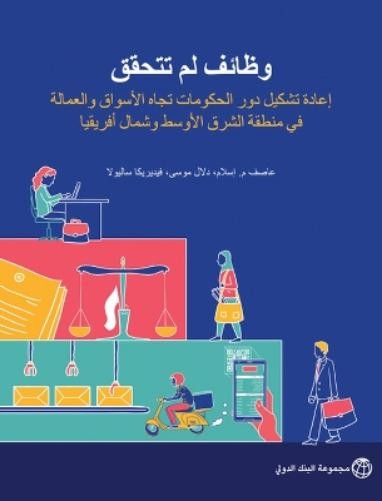
Jobs Undone : Reshaping the Role of Governments Toward Markets and Workers in the Middle East and North Africa by Dalal Moosa, Federica Saliola and Asif M. Islam (2022, Trade Paperback)

Rarewaves (696563)
98.9% positive feedback
Price:
US $66.03
ApproximatelyRM 271.61
+ $3.99 shipping
Returns:
60 days return. Buyer pays for return shipping. If you use an eBay shipping label, it will be deducted from your refund amount.
Condition:
Oops! Looks like we're having trouble connecting to our server.
Refresh your browser window to try again.
About this product
Product Identifiers
PublisherWorld Industries Bank Publications
ISBN-101464818630
ISBN-139781464818639
eBay Product ID (ePID)21067513610
Product Key Features
Number of Pages138 Pages
LanguageEnglish
Publication NameJobs Undone : Reshaping the Role of Governments Toward Markets and Workers in the Middle East and North Africa
SubjectEconomics / Microeconomics, Economics / General
Publication Year2022
TypeTextbook
AuthorDalal Moosa, Federica Saliola, Asif M. Islam
Subject AreaBusiness & Economics
FormatTrade Paperback
Dimensions
Item Height0.8 in
Item Weight12.8 Oz
Item Length11 in
Item Width8.5 in
Additional Product Features
Intended AudienceScholarly & Professional
SynopsisA decade since the spark of the Arab Spring, the Middle East and North Africa (MENA) region continues to suffer from limited creation of more and better jobs. Youth face idleness and unemployment. For those who find jobs, informality awaits. Few women attempt to enter the world of work at all. Meanwhile, the available jobs are not those of the future. These labor market outcomes are being worsened by the coronavirus (COVID-19) pandemic.Jobs Undone: Reshaping the Role of Governments toward Markets and Workers in the Middle East and North Africa explores ways to break these impasses, drawing on original research, survey data, wide-ranging literature, and young entrepreneurial voices from the region. The report finds that a prominent reason behind MENA's unmet jobs challenge is a lack of market contestability in the formal private sector. Few firms in the region enter the market, few grow, and those that exit are not necessarily less productive. Moreover, firms in the region invest little in physical capital, human capital, or research and development, and they tend to be politically connected. At the macro level, economic growth has been mediocre, labor productivity is not being driven by structural change, and the growth of the stock of capital per capita has declined.New evidence generated for this report shows that the lack of dynamism is due to the prevalence of state-owned enterprises (SOEs). They operate in sectors where there is little economic rationale for public activity and they enjoy favorable treatment--flouting the principles of competitive neutrality. Meanwhile, labor regulations add to market rigidity, while gendered laws restrict women's potential.To change this reality, the state must reshape its relationship toward markets, toward workers, and toward women. The region must create a level playing field between SOEs and the private sector, replace labor rigidities with appropriate social protection and labor market programs, and remove barriers to women's economic participation. Governments can also foster new sectors and occupations, gradually propelling market contestability and job creation. All reforms will have to rely on improved data capacity and transparency to create a new social contract between governments and the people of the region., A decade since the spark of the Arab Spring, the Middle East and North Africa (MENA) region continues to suffer from limited creation of more and better jobs. Youth face idleness and unemployment. For those who find jobs, informality awaits. Few women attempt to enter the world of work at all. Meanwhile, the available jobs are not those of the future. These labor market outcomes are being worsened by the coronavirus (COVID-19) pandemic. Jobs Undone: Reshaping the Role of Governments toward Markets and Workers in the Middle East and North Africa explores ways to break these impasses, drawing on original research, survey data, wide-ranging literature, and young entrepreneurial voices from the region. The report finds that a prominent reason behind MENA's unmet jobs challenge is a lack of market contestability in the formal private sector. Few firms in the region enter the market, few grow, and those that exit are not necessarily less productive. Moreover, firms in the region invest little in physical capital, human capital, or research and development, and they tend to be politically connected. At the macro level, economic growth has been mediocre, labor productivity is not being driven by structural change, and the growth of the stock of capital per capita has declined. New evidence generated for this report shows that the lack of dynamism is due to the prevalence of state-owned enterprises (SOEs). They operate in sectors where there is little economic rationale for public activity and they enjoy favorable treatment--flouting the principles of competitive neutrality. Meanwhile, labor regulations add to market rigidity, while gendered laws restrict women's potential. To change this reality, the state must reshape its relationship toward markets, toward workers, and toward women. The region must create a level playing field between SOEs and the private sector, replace labor rigidities with appropriate social protection and labor market programs, and remove barriers to women's economic participation. Governments can also foster new sectors and occupations, gradually propelling market contestability and job creation. All reforms will have to rely on improved data capacity and transparency to create a new social contract between governments and the people of the region., More and better jobs in the MENA region must rely on a new era of market contestability. Governments must reshape their relationships towards markets, towards workers and towards women, combining bold reforms with gradual ones and using data to create a new social contract with the people of the region.
LC Classification NumberHD8656
Be the first to write a review


