Picture 1 of 13
Stock photo


Picture 1 of 13
Stock photo


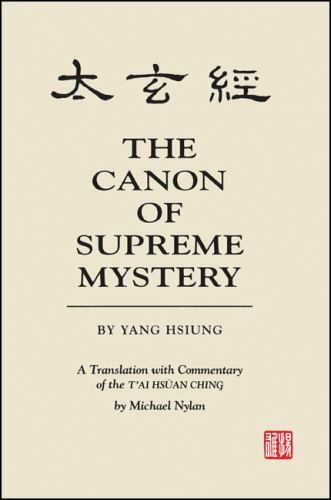
Canon of Supreme Mystery by Yang Hsiung : A Translation with Commentary of the T'Ai Hsuan Ching by Michael Nylan by Michael Nylan (1993, Hardcover)
Q
Quality Books and Music for All (2638)
100% positive feedback
Price:
US $123.24
ApproximatelyRM 509.01
+ $39.17 shipping
Returns:
30 days return. Buyer pays for return shipping. If you use an eBay shipping label, it will be deducted from your refund amount.
Condition:
Oops! Looks like we're having trouble connecting to our server.
Refresh your browser window to try again.
About this product
Product Identifiers
PublisherSTATE University of New York Press
ISBN-100791413950
ISBN-139780791413951
eBay Product ID (ePID)846313
Product Key Features
Book TitleCanon of Supreme Mystery by Yang Hsiung : A Translation with Commentary of the T'Ai Hsuan Ching by Michael Nylan
Number of Pages680 Pages
LanguageEnglish
Publication Year1993
TopicAsia / General, Divination / General
IllustratorYes
GenreBody, Mind & Spirit, History
AuthorMichael Nylan
Book SeriesSuny Series in Chinese Philosophy and Culture Ser.
FormatHardcover
Dimensions
Item Height1 in
Item Weight8 Oz
Item Length9 in
Item Width6 in
Additional Product Features
Intended AudienceTrade
LCCN92-008631
TitleLeadingThe
Dewey Edition20
Dewey Decimal181/.112
Table Of ContentPreface Introduction General Introduction to the Mystery Text On the Term "Mystery" A Capsule Biography of Yang Hsiung The Mystery in the Tradition of the Changes The Arrangement of the Mystery Significant Structure in the Mystery The First Seven Heads No. 1. Center - 18, No. 2. Full Circle - 19, No. 3. Mired - 19, No. 4. Barrier - 19, No. 5. Small - 20, No. 6. Contrariety - 20, No. 7. Ascent - 21 Every Tenth Head No. 1. Center - 22, No. 11. Divergence - 22, No. 21. Release - 22, No. 31. Packing - 23, No. 41. Response - 23, No. 51. Constancy - 24, No. 61. Embellishment - 24, No. 71. Stoppage - 25, No. 81. Nurturing - 25, General Commentary - 26 Method of Divination of the Mystery Interpretation Following Divination On Luck and Divination in the Mystery The Mystery as Divination Classic Early Notions of Ming: The Historical Background to the Problem of Fate Yang Hsiung''s Solution to the Problem of Ming Propositions About Time, Luck, and Virtue The Intellectual Debts of Yang''s New Classic Yang''s Mystery as a Chinese Summa Contra the Relativists Contra the Immortality Seekers Contra the Proponents of "Change as the Only Constant" Contra Predestination Contra the Mantic Specialists Conclusion Key Terms The Five Classics of Confucianism On Ch''i Yin/yang Five Phases Theory: Correlative Thought Self-Cultivation "Center Heart" Ritual The Meaning of Chen On the Style of the Book Glossary for the Introductory Sections Names of People Concepts and Terms Translation of the T''AI HSÜAN CHING List of Tetragrams No. 1. Center No. 2. Full Circle No. 3. Mired No. 4. Barrier No. 5. Keeping Small No. 6. Contrariety No. 7. Ascent No. 8. Opposition No. 9. Branching Out No. 10. Defectiveness/Distortion No. 11. Divergence No. 12. Youthfulness No. 13. Increase No. 14. Penetration No. 15. Reach No. 16. Contact No. 17. Holding Back No. 18. Waiting No. 19. Following No. 20. Advance No. 21. Release No. 22. Resistance No. 23. Ease No. 24. Joy No. 25. Contention No. 26. Endeavor No. 27. Duties No. 28. Change No. 29. Decisiveness No. 30. Bold Resolution No. 31. Packing No. 32. Legion No. 33. Closeness No. 34. Kinship No.35. Gathering No.36. Strength No.37. Purity No.38. Fullness No.39. Residence No.40. Law/Model No.41. Response No.42. Going To Meet No.43. Encounters No.44. Stove No.45. Greatness No.46. Enlargement No.47. Pattern No.48. Ritual No.49. Flight No.50. Vastness/Wasting No.51. Constancy No.52. Measure No.53. Eternity No.54. Unity o.55. Diminishment No.56. Closed Mouth No.57. Guardedness No.58. Closing In No.59. Massing No.60. Accumulation No.61. Embellishment No.62. Doubt No.63. Watch No.64. Sinking No.65. Inner No.66. Departure No.67. Darkening No.68. Dimming No.69. Exhaustion No.70. Severance No.71. Stoppage No.72. Hardness No.73. Completion No.74. Closure No.75. Failure No.76. Aggravation No. 77. Compliance No. 78. On the Verge No. 79. Difficulties No. 80. Laboring No. 81. Fostering Leap Year Differentials Autocommentaries Polar Oppositions of the Mystery: Hsüan ch''ung Interplay of Opposites in the Mystery: Hsüan ts''o Evolution of the Mystery: Hsüan li Illumination of the Mystery: Hsüan ying Numbers of the Mystery: Hsüan shu Elaboration of the Mystery: Hsüan wen Representations of the Mystery: Hsüan yi Diagram of the Mystery: Hsüan t''u Revelation of the Mystery: Hsüan kao Notes Bibliography Partial Index of Common Images Index
SynopsisThis is a translation, with a commentary and a long contextualizing introduction, of the only major work of Han (206 B.C. to 220 A.D.) philosophy that is still available in complete form. It is the first translation of the work into a European language and provides unique access to this formative period in Chinese history. Because Yang Hsiung's interpretations drew upon a variety of pre-Han sources and then dominated Confucian learning until the twelfth century, this text is also a valuable resource on early Chinese history, philosophy, and culture beyond the Han period. The T'ai hsüan is also one of the world's great philosophic poems comparable in scale and grandeur to Lucretius' De rerum naturum . Nathan Sivin has written that this is one of the titles on the short list of Chinese books every cultivated person should read. Han thinkers saw in this text a compelling restatement of Confucian doctrine that addressed the major objections posed by rival schools including Mohism, Taoism, Legalism and Yin-Yang Five Phase Theory. Since this Han amalgam formed the basis for the state ideology of China from 134 B.C. to 1911, an ideology that in turn provided the intellectual foundations for the Japanese and Korean states, the importance of this book can hardly be overestimated., This is a translation, with a commentary and a long contextualizing introduction, of the only major work of Han (206 B.C. to 220 A.D.) philosophy that is still available in complete form. It is the first translation of the work into a European language and provides unique access to this formative period in Chinese history. Because Yang Hsiung's interpretations drew upon a variety of pre-Han sources and then dominated Confucian learning until the twelfth century, this text is also a valuable resource on early Chinese history, philosophy, and culture beyond the Han period. The T'ai hs an is also one of the world's great philosophic poems comparable in scale and grandeur to Lucretius' De rerum naturum . Nathan Sivin has written that this is one of the titles on the short list of Chinese books every cultivated person should read. Han thinkers saw in this text a compelling restatement of Confucian doctrine that addressed the major objections posed by rival schools including Mohism, Taoism, Legalism and Yin-Yang Five Phase Theory. Since this Han amalgam formed the basis for the state ideology of China from 134 B.C. to 1911, an ideology that in turn provided the intellectual foundations for the Japanese and Korean states, the importance of this book can hardly be overestimated.
LC Classification NumberBF1770.C5.Y3613 1993
Be the first to write a review


