Picture 1 of 1
Gallery
Picture 1 of 1

Have one to sell?
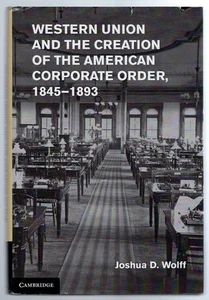
Western Union & the Creation of the American Corporate Order 1845-1893 1st 2013
US $34.99
ApproximatelyRM 144.60
Condition:
“Remainder mark tail edge, dj chip, Couple of tiny tears. Pages are clean, binding is tight.”
Oops! Looks like we're having trouble connecting to our server.
Refresh your browser window to try again.
Shipping:
US $3.50 (approx RM 14.46) USPS Media MailTM.
Located in: Los Angeles, California, United States
Delivery:
Estimated between Thu, 4 Dec and Mon, 8 Dec to 94104
Returns:
30 days return. Buyer pays for return shipping. If you use an eBay shipping label, it will be deducted from your refund amount.
Coverage:
Read item description or contact seller for details. See all detailsSee all details on coverage
(Not eligible for eBay purchase protection programmes)
About this item
Seller assumes all responsibility for this listing.
eBay item number:284243525118
Item specifics
- Condition
- Very Good
- Seller Notes
- “Remainder mark tail edge, dj chip, Couple of tiny tears. Pages are clean, binding is tight.”
- Country of Origin
- United States
- ISBN
- 9781107012288
About this product
Product Identifiers
Publisher
Cambridge University Press
ISBN-10
1107012287
ISBN-13
9781107012288
eBay Product ID (ePID)
159897106
Product Key Features
Number of Pages
318 Pages
Publication Name
Western Union and the Creation of the American Corporate Order, 1845-1893
Language
English
Publication Year
2013
Subject
United States / 19th Century, Commerce, General, Telecommunications, History, Corporate & Business History
Features
New Edition
Type
Textbook
Subject Area
Technology & Engineering, Business & Economics, History
Format
Hardcover
Dimensions
Item Height
0.9 in
Item Weight
20.2 Oz
Item Length
9 in
Item Width
6 in
Additional Product Features
Intended Audience
Scholarly & Professional
LCCN
2013-000569
Dewey Edition
23
Reviews
Advance praise: 'Joshua Wolff presents a thoroughly researched, deftly argued, and gracefully written history of America's first industrial monopoly. He demonstrates that the rise of Western Union cemented the corporate order that characterized economic life in the late nineteenth century and afterward. This book is indispensable to historians of American capitalism.' David Hochfelder, University at Albany, State University of New York, Advance praise: 'Company history is overdue for a revival. This solidly researched, lucidly framed, and engagingly written monograph reminds us of the challenge that lawmakers confront in distinguishing the financial self-interest of investors from the public good.' Richard R. John, author of Network Nation: Inventing American Telecommunications, "Company history is overdue for a revival. This solidly researched, lucidly framed, and engagingly written monograph reminds us of the challenge that lawmakers confront in distinguishing the financial self-interest of investors from the public good." - Richard R. John, author of Network Nation: Inventing American Telecommunications, "Joshua Wolff presents a thoroughly researched, deftly argued, and gracefully written history of America's first industrial monopoly. He demonstrates that the rise of Western Union cemented the corporate order that characterized economic life in the late nineteenth century and afterward. This book is indispensable to historians of American capitalism." - David Hochfelder, University at Albany, SUNY, Advance praise: 'Thorough in its research yet sweeping in its conclusions, this study of the rise of Western Union provides us with a new interpretation of the development of the telecommunications industry in the late nineteenth century - and a new way of seeing the rise of industrial capitalism. Given the role of market ideology, business power, and communications technology in our economy and society today, it is not only historically insightful but timely.' Kimberly Phillips-Fein, New York University, "Thorough in its research yet sweeping in its conclusions, this study of the rise of Western Union provides us with a new interpretation of the development of the telecommunications industry in the late nineteenth century - and a new way of seeing the rise of industrial capitalism. Given the role of market ideology, business power, and communications technology in our economy and society today, it is not only historically insightful but timely." - Kimberly Phillips-Fein, New York University, "Joshua D. Wolff's Western Union and the Creation of the American Corporate Order presents a meticulous account of the birth of big business in America. Spanning the ages of proprietary and corporate capitalism, his study uncovers the origins of our own sped-up world of global communications. This includes a familiar litany of patents, finance, politics, and business innovation that sheds important light on the relationship between technology and profit and reminds us how much capitalists hate market competition. In so doing, Wolff has deepened our understanding of the complicated relationship between private gain and public good in a liberal democracy." - Michael Zakim, Tel Aviv University, Advance praise: 'Joshua D. Wolff's Western Union and the Creation of the American Corporate Order, 18451893 presents a meticulous account of the birth of big business in America. Spanning the ages of proprietary and corporate capitalism, his study uncovers the origins of our own sped-up world of global communications. This includes a familiar litany of patents, finance, politics, and business innovation that sheds important light on the relationship between technology and profit and reminds us how much capitalists hate market competition. In so doing, Wolff has deepened our understanding of the complicated relationship between private gain and public good in a liberal democracy.' Michael Zakim, Tel Aviv University
Dewey Decimal
384.1097309034
Table Of Content
1. The meanest property in the world; 2. Midwife to monopoly; 3. 'An entering wedge' against monopoly; 4. 'A very big thing'; 5. No middle ground; 6. The specter of competition; 7. First time tragedy, second time farce; 8. Octopus of the wires.
Edition Description
New Edition
Synopsis
This work chronicles the rise of Western Union Telegraph from the early years of telecommunications to its apogee as the first corporation to monopolize an industry on a national scale. The battles over Western Union's monopoly illuminate the fierce tensions over the rising power of corporations after the Civil War and the reshaping of the American political economy., This work chronicles the rise of Western Union Telegraph from its origins in the helter-skelter ferment of antebellum capitalism to its apogee as the first corporation to monopolize an industry on a national scale. The battles that raged over Western Union's monopoly on 19th century American telecommunications - in Congress, in courts, and in the press - illuminate the fierce tensions over the rising power of corporations after the Civil War and the reshaping of American political economy. The telegraph debate reveals that what we understand as the normative relationship between private capital and public interest is the product of a historical process that was neither inevitable nor uncontested. Western Union's monopoly was not the result of market logic or a managerial revolution, but the conscious creation of entrepreneurs protecting their investments. In the process, these entrepreneurs elevated economic liberalism above traditional republican principles of public interest and helped create a new corporate order., This work chronicles the rise of Western Union Telegraph from its origins in the helter-skelter ferment of antebellum capitalism to its apogee as the first corporation to monopolize an industry on a national scale. The battles that raged over Western Union's monopoly on nineteenth-century American telecommunications - in Congress, in courts, and in the press - illuminate the fierce tensions over the rising power of corporations after the Civil War and the reshaping of American political economy. The telegraph debate reveals that what we understand as the normative relationship between private capital and public interest is the product of a historical process that was neither inevitable nor uncontested. Western Union's monopoly was not the result of market logic or a managerial revolution, but the conscious creation of entrepreneurs protecting their investments. In the process, these entrepreneurs elevated economic liberalism above traditional republican principles of public interest and helped create a new corporate order.
LC Classification Number
HE7797.W53 W65 2013
Item description from the seller
Seller feedback (782)
- u***t (462)- Feedback left by buyer.Past 6 monthsVerified purchaseStrongly recommended seller & nice packing ... Thank youThe Decorated Tile An Illustrated History of English Tile-Making and Design (#284243527207)
- s***n (155)- Feedback left by buyer.Past yearVerified purchaseExcellent book with lots of good illustrations - item arrived packaged well and as described; thanks!Anatomy For the Artist Jenó Barcsay 1963 4th impression Hardcover (#274743460570)
- g***a (204)- Feedback left by buyer.More than a year agoVerified purchaseExcellent seller: great communication; smooth transaction; prompt shipping; excellent packaging!Addison Mizner Architect To the Affluent A Sketchbook Raisonné of His Work (#274744131701)
More to explore :
- 1st Edition Western Magazines,
- 1st Edition Western Magazines in English,
- 1st Edition Westerns Antiquarian & Collectible Books,
- 1st Edition Western 1980-1999 Magazines,
- 1st Edition Western 1940-1979 Magazines,
- 1st Edition Westerns Illustrated Antiquarian & Collectible Books,
- 1st Edition Westerns Hardcover Antiquarian & Collectible Books,
- American Boy 1st Edition Magazines in English,
- Louis L'Amour 1st Edition Westerns Antiquarian & Collectible Books,
- 1st Edition Westerns 1950-Now Antiquarian & Collectible Books